
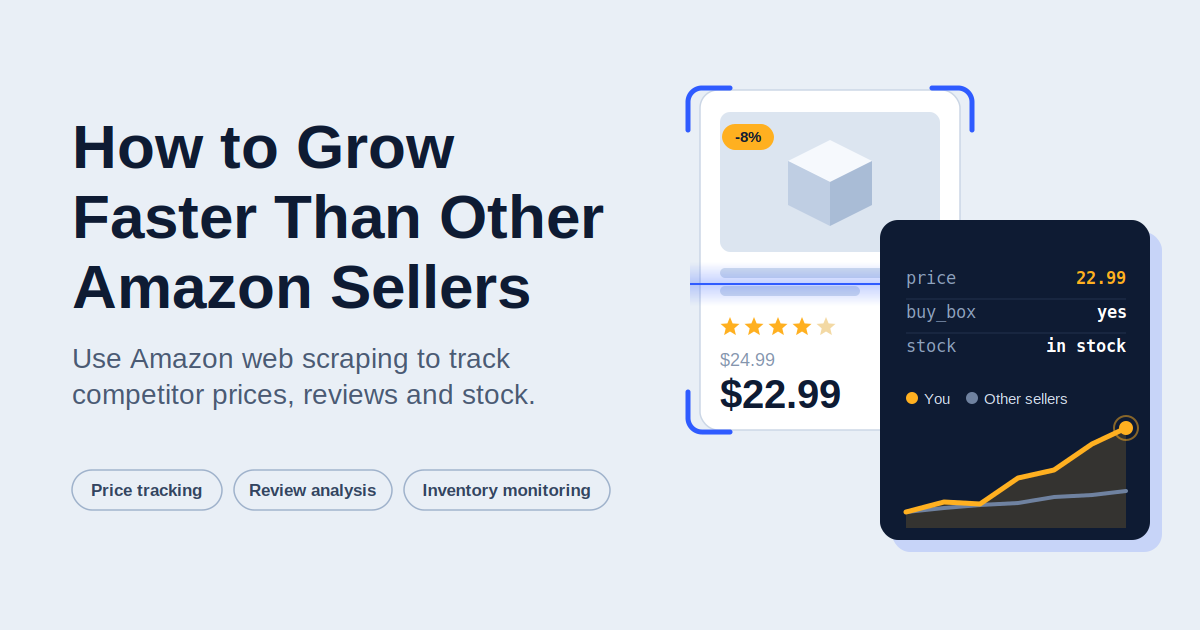
Your competitor just dropped their price by 8%, took the Buy Box, and you won't notice until tomorrow's sales report.
On Amazon, the sellers who win are rarely the ones with the best product. They're the ones with the best data, delivered faster than everyone else's.
That's why successful Amazon FBA sellers and e-commerce brands have moved from manual research to Amazon web scraping. Instead of checking listings by hand, they collect prices, reviews, rankings, and stock levels automatically, around the clock.
This guide explains why manual research fails, how automated e-commerce data extraction works, and seven practical use cases you can apply to grow your business.
Why Manual Amazon Research Holds Your Business Back
Most sellers start with spreadsheets, browser tabs, and copy-paste. That works at 10 products. It breaks at 100.
The Hidden Costs of Manual Data Collection
- It's slow. By the time you've checked 50 competitor listings, the first 20 have already changed.
- It's inconsistent. Different team members track different things at different times.
- It doesn't scale. Doubling your catalog means doubling your research hours.
- It's error-prone. Copy-paste mistakes lead to bad pricing and sourcing decisions.
- It's reactive. You see problems only after they've cost you sales.
Amazon prices, rankings, and availability can change several times a day. A weekly manual check means you're making decisions on outdated information.
The Real Cost: Lost Opportunity
Every hour spent gathering data is an hour not spent on sourcing, branding, advertising, or supplier negotiations. Sellers who grow steadily treat data collection as infrastructure, not a chore.
What Is Amazon Web Scraping?
Amazon web scraping is the automated extraction of publicly available product data from Amazon listings and search results. The data is delivered in a structured format such as a spreadsheet, database, API feed, or dashboard.
Common Amazon product data points include:
- Product titles, descriptions, and bullet points
- Prices, discounts, and Buy Box ownership
- Best Sellers Rank (BSR) and category rankings
- Customer reviews, ratings, and Q&A content
- Seller s, fulfillment type (FBA/FBM), and stock indicators
- Sponsored vs. organic search placement
- Images, variations, and listing content changes
Instead of a person visiting each page, a scraper does it at scale, on a schedule, with consistent formatting.
7 Ways Amazon Sellers Use Web Scraping to Grow
1. Competitor Price Tracking and Dynamic Repricing
Competitor price tracking is the most common use case and often delivers the fastest return.
How it works:
- Identify the competing ASINs in your niche.
- Scrape their prices, discounts, and seller data at set intervals (hourly or daily).
- Feed the data into your repricing tool or dashboard.
- Adjust your prices based on rules you define.
What sellers gain:
- Faster response to competitor price drops and promotions
- Better Buy Box competitiveness
- Protected margins, since you avoid cutting prices when competitors haven't moved
2. Amazon FBA Product Research and Niche Validation
Launching the wrong product is one of the costliest mistakes an FBA seller can make. Scraped data helps you validate demand before you invest in inventory.
What to analyze:
- BSR trends across a category over time
- Number of sellers and how concentrated the market is
- Price distribution and average review counts
- New entrants gaining traction quickly
Actionable step: Scrape the top 100 listings in a target category weekly for 8 to 12 weeks. Products with rising rank and few strong competitors are your best candidates.
3. Amazon Review Analysis and Customer Insight Mining
Reviews are free market research written by your future customers. Scraping them at scale lets you analyze thousands of reviews instead of skimming a few dozen.
What to extract:
- Recurring complaints, such as "broke after two weeks" or "smaller than expected"
- Most-praised features
- The language customers use to describe benefits, which is useful for listing copy
- Feature requests that signal gaps in the market
How sellers use it:
- Improve product design before manufacturing
- Write bullet points that mirror customer language
- Spot competitor weaknesses and build differentiation around them
4. Amazon Inventory Tracking and Stock-Level Monitoring
When a competitor runs out of stock, that's your window. Monitoring availability lets you act on it.
Use cases:
- Increase ad spend when top competitors go out of stock
- Adjust pricing when supply tightens
- Track supplier or wholesale listings so you never miss a restock or price change
- Identify products with recurring stockouts, a sign of unmet demand
5. Keyword and Search Ranking Tracking
Knowing where you and your competitors rank for key search terms guides both your listing optimization and your advertising strategy.
Track:
- Organic vs. sponsored positions for target keywords
- Ranking changes after listing updates
- Which competitors dominate your most valuable keywords
6. Listing and Content Change Monitoring
Competitors constantly test titles, images, pricing, and A+ Content. Automated monitoring alerts you when they change something, so you can learn from what's working instead of guessing.
7. Market Intelligence and Brand Protection at Scale
Brands and multi-channel store managers also use e-commerce data extraction to:
- Compare Amazon pricing against their own Shopify or WooCommerce store
- Enforce MAP (Minimum Advertised Price) policies across resellers
- Detect unauthorized sellers or counterfeit listings
- Build internal dashboards that combine pricing, sales, and competitor data
How Automated Data Extraction Works
You don't need to become a developer to benefit from scraping. A professional data pipeline typically follows these steps:
- Define your goals. Which ASINs, categories, keywords, or sellers matter to your business?
- Set scope and frequency. Do you need hourly prices or weekly category snapshots?
- Build and maintain the scrapers. Amazon's layout changes and anti-bot protections require ongoing maintenance.
- Clean and structure the data. Raw data is normalized, deduplicated, and validated.
- Deliver it where you work. Options include CSV/Excel, Google Sheets, API, database, or BI dashboard.
- Act on it. Feed it into repricing rules, alerts, or reports.
Why DIY Scraping Often Fails
Many sellers try a browser extension or a quick script and hit the same walls:
- IP blocks and CAPTCHAs
- Broken scrapers after page layout changes
- Inaccurate or incomplete data
- Regional differences in pricing and availability
- Hours lost to maintenance instead of growth
A dedicated web scraping partner solves these problems, giving you reliable data without the engineering burden.
What Data-Driven Growth Actually Looks Like
Scraping alone won't grow your revenue. It's a force multiplier for sellers who combine reliable data with sound execution.
| Data Advantage | Business Impact |
|---|---|
| Faster competitor price awareness | Higher Buy Box share, protected margins |
| Validated product research | Fewer failed launches, better inventory ROI |
| Review-driven product improvements | Better ratings, higher conversion |
| Stock-out and trend monitoring | Smarter ad spend and timing |
| Automated reporting | Team time redirected to growth |
Growth compounds when you stop spending time collecting data and start spending it acting on data.
Is Amazon Web Scraping Legal and Ethical?
Scraping publicly available data is common practice in e-commerce, but how you do it matters. Best practices include:
- Collecting only publicly visible information
- Avoiding personal data and respecting privacy regulations such as GDPR and CCPA
- Using responsible request rates
- Reviewing the terms of service of any platform you collect from
- Working with a provider that understands compliance
Legal requirements vary by jurisdiction and use case, so consult legal counsel for your specific situation.
How to Get Started: A Simple 5-Step Plan
- Pick one high-impact goal. Price tracking, product research, or review analysis is a good starting point.
- List your target ASINs, keywords, or categories. Start with your top 20 to 50 competitors.
- Decide on frequency and format. Daily prices in Google Sheets is a common first setup.
- Run a pilot for 2 to 4 weeks. Measure changes in Buy Box share, margin, or research time saved.
- Expand what works. Add more data points, more marketplaces, and more automation.
Ready to Grow With Data? Let's Build Your Custom Amazon Data Solution
Your competitors are already making faster, smarter decisions with automated data. Every week you rely on manual research is a week they pull further ahead.
At Webcrawlio data solutions, we build custom web scraping solutions for Amazon sellers, e-commerce brands, and online store managers, including:
- Real-time competitor price tracking
- Product, review, and ranking data extraction
- Inventory and Buy Box monitoring
- Clean, ready-to-use data delivered to your tools
- Fully managed service, with no maintenance on your side
Contact us today for a free consultation and tell us what data you need. We'll show you how to turn it into growth.
Frequently Asked Questions
What data can I extract from Amazon?
Publicly available product information, including titles, prices, ratings, reviews, rankings, seller details, and availability.
How often can Amazon data be updated?
It depends on your needs. Many clients choose hourly, daily, or weekly refreshes.
Do I need technical skills to use web scraping?
No. A managed service builds, runs, and maintains the scrapers, then delivers data in your preferred format.
Can web scraping work for marketplaces beyond Amazon?
Yes. The same approach applies to Walmart, eBay, Shopify stores, and other e-commerce sites.
Need custom data extraction for your business?
Tell us your target platforms, volume and fields. We'll provide feasibility assessment, sample data and an accurate quote within 24 hours.
Talk to our data team